
Energy guide · Updated October 2026
Energy-efficient windows for North Texas homes
In North Texas the most important number on a window label is SHGC, how much of the sun's heat gets through the glass. ENERGY STAR asks for an SHGC of 0.23 or lower in every DFW county, plus a U-factor of 0.32 or lower in Dallas and Tarrant counties and 0.28 or lower in Collin and Denton.
ENERGY STAR targets for DFW counties
ENERGY STAR splits the country into four climate zones and sets window targets for each. The Metroplex straddles two of them, so the right glass depends on your county.
| County | Zone | U-factor | SHGC | Cities we serve |
|---|---|---|---|---|
| Dallas County | Southern | U-factor ≤ 0.32 | SHGC ≤ 0.23 | Dallas, Richardson, Garland, Carrollton, Irving, Rowlett, Mesquite |
| Tarrant County | Southern | U-factor ≤ 0.32 | SHGC ≤ 0.23 | Fort Worth, Arlington |
| Collin County | South-Central | U-factor ≤ 0.28 | SHGC ≤ 0.23 | Plano, Frisco, McKinney, Allen, Richardson, Carrollton |
| Denton County | South-Central | U-factor ≤ 0.28 | SHGC ≤ 0.23 | Frisco, Carrollton, Denton, Lewisville, Flower Mound |
Lower numbers are better for both. Some cities, like Carrollton, Frisco and Richardson, cross county lines; there we recommend glass that meets the stricter South-Central target so you're covered either way. Source: ENERGY STAR climate zones by county and Version 7.0 window criteria.
How to read a window label
Every rated window carries a label from the National Fenestration Rating Council (NFRC). These are the numbers on it, and what they mean for a Texas home.
U-factor
How well the whole window keeps heat from passing through it. Lower is better. It matters most on cold nights and the hottest afternoons, when the gap between indoor and outdoor temperatures is widest.
Solar heat gain coefficient (SHGC)
The share of the sun's heat that gets through, from 0 to 1. In a cooling-dominated climate like ours, this is the number that most affects summer comfort and your electric bill. Look for 0.23 or lower.
Visible transmittance (VT)
How much daylight comes through. Higher means brighter rooms. Good Low-E glass keeps VT high while keeping SHGC low.
Air leakage
How much air seeps through the window itself. Lower is better; it's one reason tight- sealing styles like casement and picture windows perform so well.
Low-E glass: the biggest upgrade for Texas heat
Low-E (low-emissivity) glass has a microscopically thin metallic coating that reflects infrared heat while letting visible light through. In summer it keeps the sun's heat outside; it also filters most of the UV light that fades floors, rugs and furniture.
Coatings are tuned for different climates. For North Texas, choose a coating designed for a low SHGC rather than one built to capture winter sun.
Panes, gas fill and spacers
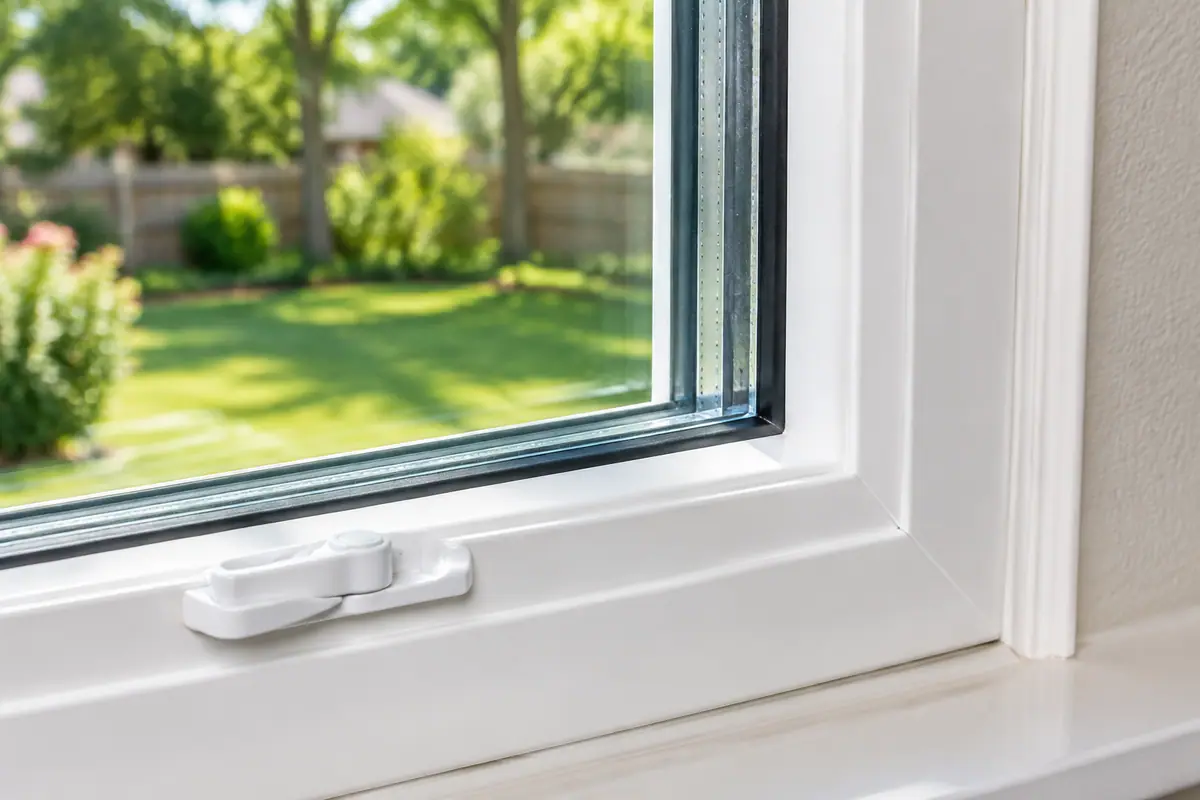
Double-pane windows seal two layers of glass around an insulating space, often filled with argon gas, which slows heat transfer better than air. Warm-edge spacers around the edge of the glass reduce heat loss and condensation at the perimeter.
When that seal fails, moisture gets between the panes and the glass fogs. Foggy glass can't be wiped clean, and it's one of the clearest signs it's time for replacement windows.
Triple-pane glass adds a third layer. It helps most in cold northern climates; here, a low-SHGC double-pane window usually delivers more comfort for the money.
Vinyl vs aluminum frames
Aluminum conducts heat quickly, so aluminum frames get hot to the touch in summer and sweat in winter. Many 1960s–90s homes across Garland, Richardson, Mesquite and Arlington still have them. Vinyl frames insulate far better, never need paint and hold up well to North Texas sun.
Which windows to replace first
If you're replacing in phases, start where the sun does the most damage:
- West-facing windows, which take the strongest afternoon sun.
- South-facing windows, which get sun for much of the day.
- Large picture windows and bays, where there's simply more glass.
- Upstairs rooms, which already run hotter than the rest of the house.
Why installation matters as much as the window
A top-rated window still leaks if the gap around it isn't sealed. A good installation fills that gap with insulation, seals the frame to the opening and flashes it so water drains away. That's why we measure every opening and install with our own experienced crew, and why the installation method belongs on any quote.
Comfort you can feel
Stay cool, calm and comfortable — even in August
Old aluminum and single-pane windows are like leaving a door open all summer. Our double-pane vinyl windows are built for North Texas, and we'll recommend glass that meets ENERGY STAR guidelines for your county.

Block the Texas heat
Low-E glass reflects much of the sun's heat while letting the light in.

Lower cooling bills
Sealed double-pane glass keeps cool air in, so your A/C runs less.

A quieter home
Two panes of glass soften traffic, neighbors and storms.

Less fading
Low-E coatings filter UV rays that fade floors and furniture.

“It has made a difference in my electric bill — it has saved me money.”
FAQ
Energy-efficient window questions
Still wondering about something? Call us at (469) 457-4049 — a real person will pick up. Or browse the full window replacement FAQ.
Is triple-pane glass worth it in Texas?
Rarely. North Texas homes spend far more energy on cooling than heating, so a low SHGC does more for your bills than the extra insulation of a third pane. Well-made double-pane Low-E glass meets ENERGY STAR in every DFW county.
Will Low-E glass make my rooms darker?
Modern Low-E coatings are designed to let most visible light through while reflecting heat. Some have a faint tint you may notice next to clear glass; ask to see samples in your own light at your free estimate.
Will energy-efficient windows lower my electric bill?
They reduce how much heat gets in, so your A/C runs less. How much you save depends on your old windows, which way they face and your home's insulation. Customers replacing old aluminum or single-pane windows tend to notice the biggest difference.
What does SHGC mean?
Solar heat gain coefficient: the share of the sun's heat that passes through the window, from 0 to 1. Lower is better in Texas. ENERGY STAR asks for 0.23 or lower in every DFW county.
Do I need ENERGY STAR windows?
It isn't required, but it's an easy, independent benchmark. Every window we recommend for DFW homes can be ordered with glass that meets the ENERGY STAR target for your county.
Keep exploring
- Replacement windowsCustom double-pane vinyl windows with Low-E glass, in every style.Read more
- Window replacement costWhat drives the price in DFW, and what a fair written quote includes.Read more
- Service areasEvery North Texas city we serve, from Fort Worth to McKinney.Read more
- Plantation shuttersMade-to-measure shutters for privacy, light control and cooler rooms.Read more

Find the right glass for your home
We'll check which way your windows face, recommend glass that meets ENERGY STAR for your county and leave a written price.
- Free in-home estimate & written quote
- Rated 5.0 stars by 110+ neighbors
- Financing available for qualified buyers
Get your free estimate